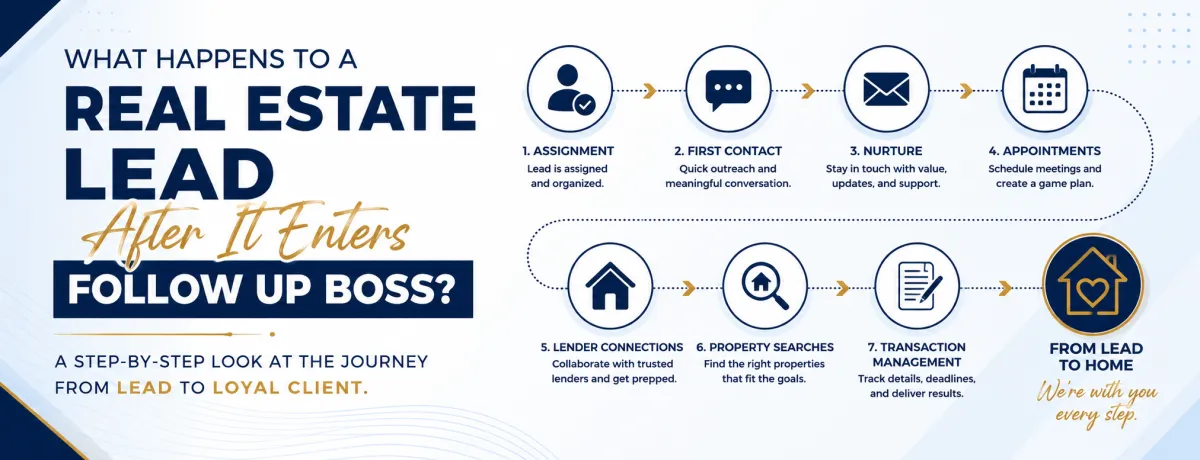
What Happens to a Real Estate Lead After It Enters Follow Up Boss?
A real estate lead is not just a name, phone number, and email address sitting in a database.
There is a person behind that information.
Maybe they are scrolling through homes after putting their kids to bed. Maybe they are wondering whether they can afford to buy. Maybe they need to sell before making their next move. Maybe they are relocating to Central Florida and have no idea where to begin.
That is why what happens after a lead comes in matters so much.
I grew up here in Central Florida, and after years in hospitality, real estate, coaching agents, and working on the mortgage side of the business, one lesson has stayed consistent: good service requires more than responding once. It requires organization, communication, follow-through, and knowing what the client needs next.
That is where a system like Follow Up Boss can become part of the process.
The exact workflow can vary depending on how an agent or real estate team configures the platform, but here is a look at what can happen from the moment a new lead enters Follow Up Boss through appointments, financing, property searches, and eventually the transaction itself.
Step 1: The Lead Enters the System and Gets Assigned
The first thing that has to happen is simple: someone needs to take responsibility for the relationship.
Follow Up Boss allows incoming web leads to be routed through its Lead Flow system. Depending on how an account is configured, a lead can be assigned to an individual agent or a group, and rules can also take factors such as source, location, price, tags, or other information into consideration. An automation can also be connected to that incoming lead flow. (Follow Up Boss Help Center)
That assignment matters.
One of the easiest ways for opportunities to fall through the cracks is when everyone assumes someone else is handling them.
A good CRM workflow creates ownership.
But assignment is only the beginning. A CRM can organize the opportunity. It cannot replace the human being who needs to make the connection.
Step 2: First Contact Begins
Once a lead is assigned, the next goal is to understand why that person reached out in the first place.
Are they trying to buy?
Sell?
Invest?
Relocate?
Are they six months away, or do they need to move next month?
Follow Up Boss can use automations to help initiate communication, including automated first texts or emails depending on how the system is configured. The platform also tracks whether assigned leads have received outbound contact attempts. (Follow Up Boss Help Center)
Technology can help us respond quickly, but I believe the real work begins when we start listening.
My hospitality background taught me to pay attention to what someone actually needs instead of immediately trying to sell them something.
That is especially important in real estate.
Sometimes the first conversation reveals that a buyer needs financing guidance before looking at homes. Sometimes a seller needs time to prepare. Sometimes an investor is looking for something very specific.
The better we understand the person, the better the next step becomes.
Step 3: The Lead Moves Into Nurture
Not every lead who reaches out today is ready to sign a contract tomorrow.
And that is completely normal.
Real estate decisions happen on people's timelines, not ours.
This is where nurture becomes important.
Follow Up Boss includes Action Plans and automations that can help agents organize future communication, create tasks, and send scheduled emails based on the workflow an agent or team has built. (Follow Up Boss Help Center)
For me, nurture should never mean bothering someone until they finally respond.
It should mean staying useful.
Maybe that is checking in about their timeline.
Maybe it is discussing what they need to do before buying.
Maybe it is sharing information about the Central Florida market.
Maybe their plans have completely changed.
Good follow-up gives people room while making sure they know they have someone they can come back to when they are ready.
Step 4: Conversations Turn Into Appointments
Eventually, the relationship moves from "we should talk" to an actual appointment.
That could be a buyer consultation, seller consultation, property showing, strategy conversation, or another meeting related to the client's move.
Follow Up Boss allows appointments to be connected to lead profiles and can sync with Google Calendar or Microsoft 365 Calendar when those accounts are connected. Tasks and appointments can then become part of the organized record surrounding that client. (Follow Up Boss Help Center)
This is an important transition.
An inquiry becomes a real conversation.
A conversation becomes a plan.
And the plan becomes specific.
What are we trying to accomplish?
What needs to happen first?
What obstacles could get in the way?
That is the part of real estate I enjoy most. I am a strategist by nature. I want people to understand not only what we are doing, but why we are doing it.
Step 5: Financing Gets Connected to the Conversation
For many buyers, finding the right home is only one side of the equation.
The other side is financing.
Follow Up Boss can support lender collaboration in several ways. Lenders can be added as users in certain setups so they can collaborate on leads, add notes, and work alongside the assigned agent. Accounts can also track lender information without making a lender a user. Specific integrations may provide additional financing visibility. (Follow Up Boss Help Center)
This is one area where my experience running a mortgage franchise, Mpire Financial, has given me an especially valuable perspective.
I understand how closely the real estate and financing conversations can be connected.
A buyer may fall in love with a home, but we still need to understand the financing picture. What can they comfortably purchase? What information does the lender need? Are there financing questions that need to be answered before we start making offers?
The goal should be coordination.
The real estate agent, lender, and client should not feel like three separate groups trying to figure out what the others are doing.
Step 6: Property Searches Become More Focused
Once we understand the buyer's needs and financing position, the property search becomes much more meaningful.
Depending on the website, IDX provider, and integrations being used, property-search activity can flow into or be visible through Follow Up Boss. Some integrations can show information such as registrations, properties viewed or saved, and other buyer activity. Follow Up Boss also supports listing search and property alerts in certain Zillow-integrated environments and supported markets. (Follow Up Boss Help Center)
That information can help start better conversations.
If someone keeps looking at homes in the same neighborhood, that tells us something.
If their search suddenly shifts in price, location, or property type, that may tell us something too.
But I never want technology making assumptions for the client.
Data gives us clues.
Conversation gives us answers.
Step 7: The Lead Becomes an Active Transaction
Eventually, some leads become clients, offers get written, contracts are accepted, and the entire relationship enters another phase.
Now follow-up is not simply about staying in touch.
It is about managing important dates, communication, responsibilities, financing, inspections, negotiations, and all the moving parts that come with a real estate transaction.
Follow Up Boss includes deal pipelines that can be used to track opportunities through stages such as contract, offer, pending, and closed. Automations can also be connected to changes in deal stages, while the platform integrates with a variety of transaction-management systems. (Follow Up Boss Help Center)
This is where organization really shows its value.
The client should not have to wonder whether everyone involved remembers what happens next.
Systems help professionals keep track of details.
People provide the judgment, communication, negotiation, and care.
You need both.
The CRM Is the System. The Relationship Is the Business.
I have been in service-oriented roles for most of my professional life, and I have learned that people remember how well you communicated with them.
Follow Up Boss can help organize a real estate relationship from the initial inquiry through follow-up, appointments, lender coordination, property activity, and deal tracking.
But the software is not the relationship.
The relationship is built when someone answers the phone.
When they listen.
When they explain.
When they remember what matters to the client.
When they follow through.
Whether you are buying your first home, selling a property, growing an investment portfolio, or trying to figure out what your next move should be, you deserve more than being treated like another lead in a database.
You deserve a strategy.
And you deserve someone who stays involved from the first conversation through the decisions that follow.
If you are thinking about making a move in Central Florida, I would be happy to talk through what that process could look like for you.
